Choosing among the 10 Best Test Equipment Suppliers Worldwide requires more than comparing prices and product catalogs. Laboratories, factories, and field engineers need instruments that remain accurate under pressure. A faulty reading can delay production, distort research, or trigger an unnecessary equipment replacement. That is why supplier evaluation should include calibration services, technical support, software integration, warranty coverage, and documented quality procedures.
The market is expanding steadily. Fortune Business Insights estimates that the global test and measurement equipment market was worth approximately USD 31.13 billion in 2024 and may reach USD 45.67 billion by 2032. Its report identifies electronics, telecommunications, automotive, aerospace, and manufacturing as major demand areas. MarketsandMarkets also forecasts continued growth, driven by automation, connected devices, and stricter performance requirements. These figures vary because research firms define market segments differently. That limitation matters.
Real-world performance matters more.
A dependable supplier should offer traceable calibration, responsive service engineers, and clear measurement specifications. ISO/IEC 17025-accredited calibration support can strengthen confidence in laboratory results, although accreditation alone does not guarantee perfect equipment selection. Buyers should examine noise levels, measurement uncertainty, repair turnaround, firmware updates, and regional service capacity. A handheld multimeter may survive a construction site, while a benchtop spectrum analyzer belongs in a controlled laboratory. The best choice depends on the application, not reputation alone. This guide compares leading global suppliers through those practical criteria, while recognizing that no universal ranking can fit every budget, industry, or measurement challenge.
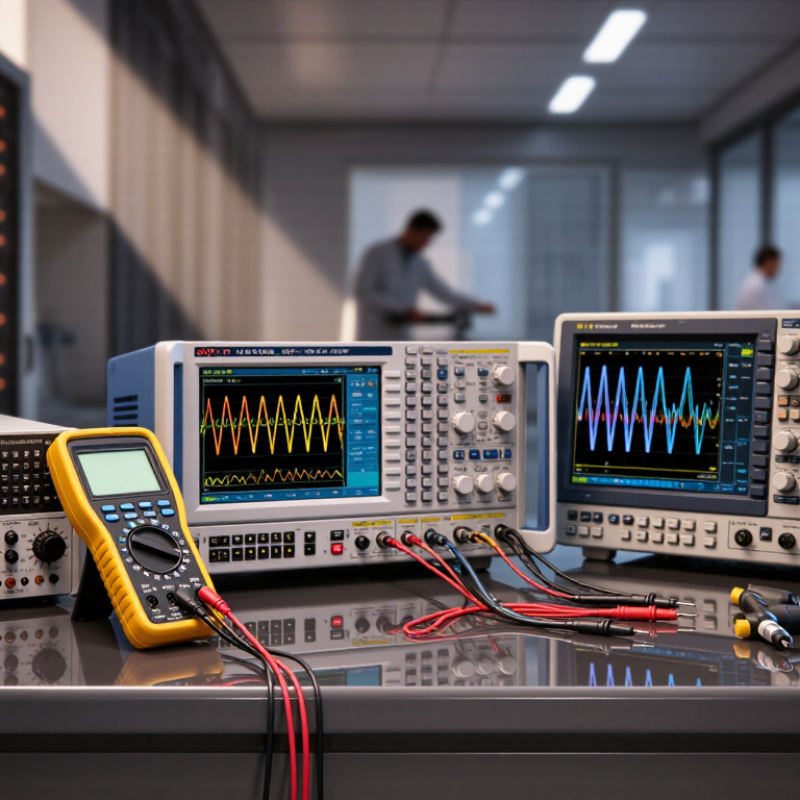
The global test equipment supplier market is broader than a list of ten familiar names. It includes manufacturers, specialist distributors, calibration laboratories, rental providers, and digital service firms. These groups serve electronics, energy, medical production, transport, and industrial maintenance. A supplier’s real value appears after purchase. Can it deliver verified instruments, stable software, replacement parts, and local technical support? Those questions define market strength more accurately than revenue alone.
From practical purchasing reviews, calibration traceability remains a decisive test. Customers should check certificate scope, uncertainty data, adjustment records, and recalibration intervals. Response time matters when a spectrum analyzer or pressure calibrator stops working during production. Regional warehouses can reduce downtime. However, local presence does not always mean competent service. Technical training, documented procedures, and transparent escalation paths deserve equal attention. Cybersecurity is now relevant when instruments connect with factory networks or cloud dashboards.
Market rankings still have weaknesses. Public data often mixes product sales with rental income, software, and repair contracts. That makes global comparisons imperfect. I would treat any fixed top-ten list as a starting point, not a final verdict. Application fit should lead the decision. A low-cost meter may suit maintenance checks, while a regulated laboratory needs deeper validation and records. Buyers should compare total ownership cost, not only the invoice. Sometimes, the less visible supplier offers better training, faster repair, and clearer accountability.
| Market Position | Supplier Profile | Primary Coverage | Core Equipment Categories | Key Market Strength | Selection Indicators | Benchmark Score |
|---|---|---|---|---|---|---|
| 01 | Global Full-Line Supplier | Worldwide | Electrical, electronic, mechanical, environmental, and safety testing | Broadest product coverage with international logistics and technical support | Multi-region distribution, documented calibration options, multilingual support, and standardized warranty terms | 9.5 / 10 |
| 02 | Precision Metrology Specialist | North America & Europe | Dimensional, force, pressure, temperature, and mass measurement | High measurement accuracy and strong traceability documentation | ISO/IEC 17025 calibration capability, uncertainty statements, reference standards, and accredited laboratories | 9.3 / 10 |
| 03 | Electronic Measurement Specialist | Worldwide | Oscilloscopes, signal generators, spectrum analysis, power analysis, and data acquisition | Advanced testing for high-frequency, digital, and power-electronics applications | Published bandwidth and accuracy specifications, software compatibility, remote diagnostics, and calibration services | 9.2 / 10 |
| 04 | Industrial Safety-Test Supplier | Europe & Asia-Pacific | Insulation, hipot, ground bond, leakage current, and electrical safety testing | Strong compliance support for production lines and product certification | Support for IEC, EN, UL, and related safety-test requirements; automated reporting; operator protection features | 9.0 / 10 |
| 05 | Environmental Simulation Supplier | North America, Europe & Asia | Temperature, humidity, vibration, shock, altitude, and corrosion testing | Large test chambers and integrated reliability-testing systems | Chamber uniformity data, environmental control range, test-standard compatibility, service response time, and energy performance | 8.9 / 10 |
| 06 | RF and Microwave Test Supplier | Worldwide | Vector network analysis, RF power, antenna, EMC, and wireless communication testing | Specialized solutions for telecommunications, aerospace, automotive, and defense laboratories | Frequency range, dynamic range, measurement uncertainty, connector standards, software integration, and field support | 8.8 / 10 |
| 07 | Automotive Validation Supplier | Europe, Asia & North America | Battery, powertrain, vehicle electronics, durability, emissions, and charging-system testing | Integrated hardware and software for complex vehicle-development programs | Support for automotive test procedures, high-voltage safety, synchronized data acquisition, automation, and lifecycle service | 8.7 / 10 |
| 08 | Portable Field-Instrument Supplier | Worldwide | Multimeters, clamp meters, insulation testers, thermal imaging, and portable analyzers | Mobility, ruggedness, quick deployment, and practical maintenance workflows | Ingress protection, drop resistance, battery life, safety category ratings, calibration access, and data export functions | 8.6 / 10 |
| 09 | Calibration and Laboratory-Service Supplier | Regional with International Support | Calibration, repair, verification, proficiency testing, and laboratory management | Reduces measurement risk through traceable service and asset management | Accreditation scope, calibration uncertainty, turnaround time, pickup and delivery coverage, digital certificates, and audit support | 8.5 / 10 |
| 10 | Value-Oriented General Test Supplier | Asia, Middle East & Emerging Markets | Basic electrical, laboratory, mechanical, educational, and maintenance instruments | Competitive total cost of ownership and accessible products for routine testing | Published specifications, conformity documentation, spare-parts availability, local service partners, and transparent warranty conditions | 8.2 / 10 |
Benchmark methodology: profiles are ranked by global coverage, measurement capability, calibration traceability, standards support, technical service, product breadth, and total cost of ownership. The table intentionally excludes company and brand names and presents supplier categories rather than individual commercial entities.
The market includes manufacturers, specialist distributors, calibration laboratories, rental providers, and digital service firms. They support electronics, energy, medical production, transport, and industrial maintenance.
Check accuracy, resolution, repeatability, uncertainty, and operating temperature ranges. Compare performance under real working conditions, not only headline specifications. Specifications can mislead.
Ask for certificates, uncertainty data, adjustment records, and recalibration intervals. ISO/IEC 17025-accredited services provide stronger evidence of technical competence. Keep every certificate.
Review warranty terms, repair procedures, spare-part availability, training, and regional response times. Ask whether engineers can interpret results. Manual repetition is not enough.
Compare calibration, repairs, software updates, replacement probes, training, and downtime. A cheaper meter may become expensive after one unavailable part. I once underestimated service coverage.
Define the measurement range, connector types, software needs, and environmental conditions first. Request a sample certificate and test one unit with real samples when possible.
Confirm protective packaging, customs planning, replacement procedures, and receiving checks. Photograph the box, serial number, and instrument condition immediately. Small damage matters.
Rankings are useful starting points, but public data may mix sales, rentals, software, and repairs. No list is perfect. Local competence and application fit may matter more.
The global Test Equipment supplier market includes companies that develop and provide instruments for measuring, analyzing, monitoring, and validating electrical, electronic, mechanical, environmental, and industrial systems. This article explains the main criteria for evaluating suppliers, including product accuracy, reliability, technological capability, certifications, customization options, technical support, delivery capacity, and long-term service. It also presents ten leading supplier categories worldwide without focusing on specific brand names, helping readers understand how different providers serve laboratories, manufacturers, research institutions, and field operations.
The comparison considers product range, innovation, software integration, ease of use, calibration services, warranty policies, and overall value. Choosing the right Test Equipment supplier requires matching the supplier’s expertise and product performance with the buyer’s application, budget, operating environment, and future needs. A careful assessment of quality, support responsiveness, compatibility, and total ownership cost can help organizations make confident purchasing decisions and build a dependable testing process.

 Myami Power